Think First. Refine Later.

A decision framework that helps newer UX researchers know how much AI to use, and when.

Role

UX Researcher & Designer

Timeline

Spring 2026, 14 weeks

Methods

20 interviews, thematic analysis, concept testing, prototyping

Tools

Figma, HTML/CSS prototype

Overview

Newer UX researchers are entering a profession where AI is increasing expected, but rarely scaffolded. This project explored the moment before prompting when a researcher is choosing intent, stakes, platform, framing, and language all at once.

Using AI is easy. Using it well takes judgement.

CHALLENGE

Speed without distance

Researchers are expected to move faster without sacrificing the nuance, judgment, and human connection that make research valuable.

AUDIENCE

Newer UX researchers

Researchers who are expected to use AI before they have built the years of pattern recognition senior practitioners rely on.

OUTCOME

Decision framework

A platform-agnostic tool that helps define the task, select a prompt scaffold, add context, and bring the final prompt into any approved AI platform.

Problem

AI is now embedded in nearly every stage of UX research, not because researchers necessarily sought it out, but because the industry is rapidly adopting it. Researchers are expected to move faster while maintaining the same level of rigor, forcing them to balance efficiency with confidence in their findings. Whether they are new to the field or experienced practitioners, they are being asked to rely on AI tools that can summarize, synthesize, and generate insights, often without transparency into how those outputs were produced. This creates a growing gap between speed and human judgment.

If AI accelerates research processes, how might we help researchers use it more intentionally?

Research

The project started with an open-ended question: How are UX researchers actually using AI day to day? I conducted twenty 45 to 75-minute semi-structured interviews with researchers across startups, SaaS companies, enterprises, banking, insurance, and other regulated contexts. Questions focused on workflows, trust, hesitation, company pressure, and moments where AI supported or disrupted the work.

73%

Reported feeling external pressure from their company to incorporate AI into their workflow.

87%

Described prompting as one of the biggest barriers to getting useful AI output.

100%

Developed personal workarounds to reconnect with the original research data.

Studying behavior around AI, not just the tools.

I began by mapping which tools researchers used and where those tools appeared in the research process. But the same platforms and concerns kept appearing across companies. The more meaningful differences were in what researchers did when they did not trust the output.

Researchers were re-transcribing quotes by hand, rebuilding charts AI had already generated, returning to source transcripts, and writing "do not hallucinate" into their prompts. These workarounds were creating safeguards to protect the accuracy and integrity of their work.

Every researcher I interviewed had developed a workaround to reconnect with the data

Three patterns that shaped the design
01

Trust breaks when the source disappears.

Researchers were most hesitant when AI summarized qualitative data, attributed quotes, or generated insights without showing how it reached them. Their response was to verify transcripts, request timestamps, and limit how much data they uploaded at once.

Design implication
Keep source material, project context, and researcher-authored thinking visible.
02

Company context shapes AI use.

Some researchers were evaluated on AI literacy. Others could only use one approved platform because of security and compliance restrictions. The environments were different, but researchers in both were creating safeguards to protect their work.

Design implication
Remain platform-agnostic and do not assume equal access, freedom, or company policy.
03

Confidence changes throughout the interaction.

One researcher described confidence as a curve. It began low while they learned the prompt, rose once the output became useful, and fell again as the conversation grew longer and the model began losing earlier context.

Design implication
Support the moment before prompting, when the task, context, and boundaries are defined.

The project went through four real pivots: from cataloging tools, to studying behavior, to realizing that company context drove AI use more than individual preference did. A senior researcher at a company with strict compliance rules and a researcher graded on "AI literacy" at a fast-moving company were doing the same thing for opposite reasons: protecting the integrity of their work.

What I learned by narrowing

The project became stronger as the research removed possibilities. What began as an investigation into AI tools shifted toward the behavior surrounding them. Company pressure explained why AI entered the workflow, but the workarounds revealed the deeper concern: researchers were trying to move faster without losing their understanding of the data. The final opportunity became supporting judgment before AI begins shaping the work.

The Solution

Think First. Refine Later. helps newer researchers decide how much AI integration is appropriate for a task, then guides them through creating a structured, context-grounded prompt that can travel into any AI platform.

A framework that lives in the prompting moment

01 · Quadrant

Name the task before naming the tool

A simple 2x2 (open vs. closed task, low vs. high stakes) sorts any task into one of four modes: Discover, Pressure Testing, Iterate, or Polish. Naming the mode sets expectations for what AI should (and shouldn't) do.

02 · Library

Start from a scaffold, not a blank page

Newer researchers found a blank prompt box as intimidating as a blank document. The Library step offers a scaffolded starting prompt matched to the chosen quadrant, cutting straight through the prompting struggle 87% of participants named.

03 · Customize

Ground the prompt in real context

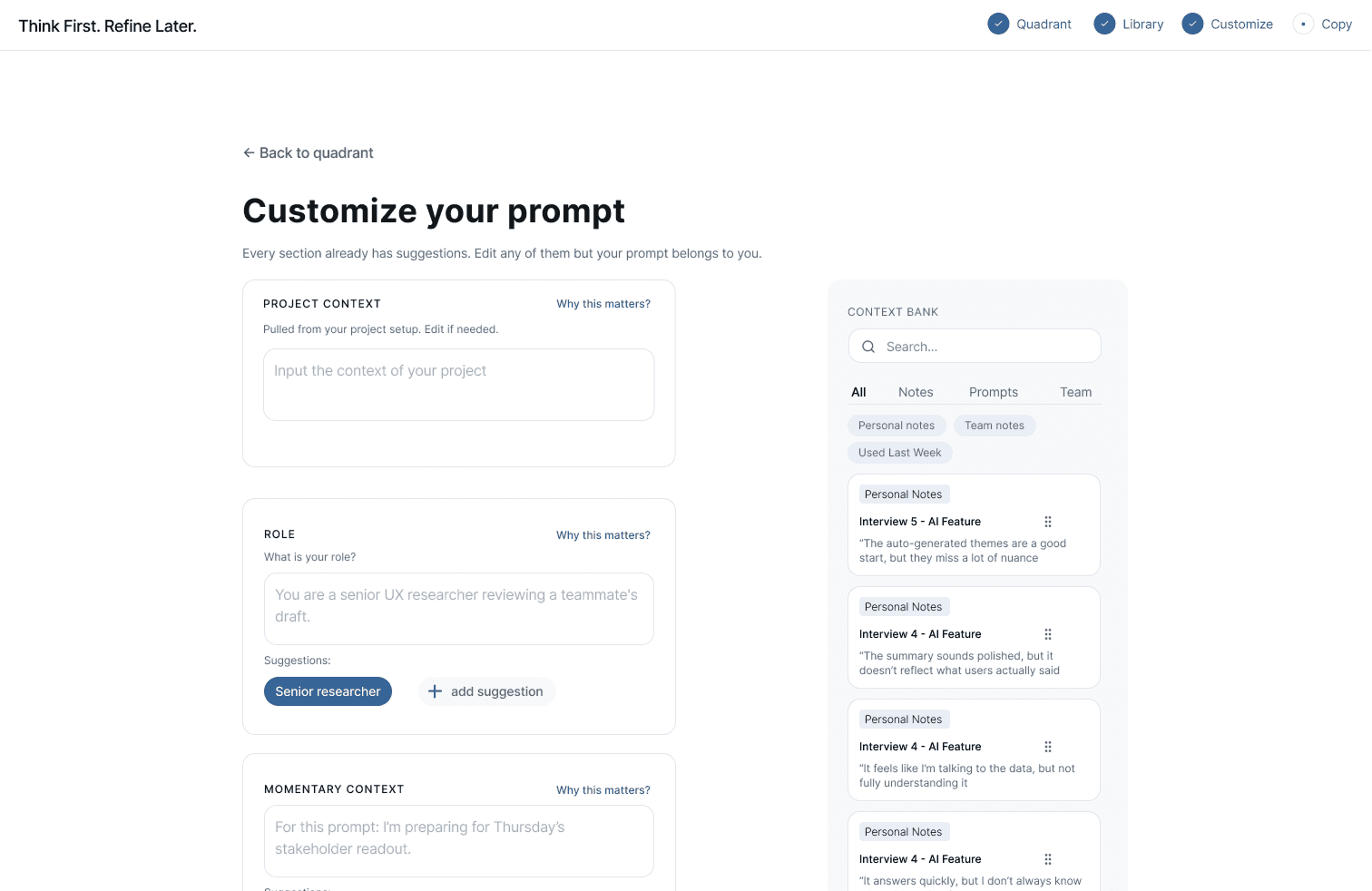
The researcher fills in role, project context, and momentary context (what's true right now, not just in general). A Context Bank surfaces personal and team notes so hard-won context doesn't have to be retyped from memory every time.

04 · Copy

Take it anywhere

The finished prompt is copied into whatever AI platform the researcher's company allows. Nothing is sent to an AI model from inside the tool itself, and nothing is locked to one platform, a deliberate choice, since every participant's tool stack looked different and none of them were staying still.

Why It Holds Up

It's platform-agnostic. No tool named in the interviews was safe from being replaced within a year. A framework tied to a specific AI would have an expiration date.

It works inside compliance constraints, because it produces a prompt rather than sending data anywhere, it functions even in banking and insurance environments where AI use is tightly restricted.

In concept testing, two things landed immediately: the quadrant vocabulary (several researchers said it named a distinction they were already making but had no word for) and the Context Bank, valued as a way to keep team knowledge present without rewriting it every time.

Impact

Designed to support researchers before AI shapes the work.

Who
Current Challenge
How the Framework Helps
Early-career researchers
Uncertainty about when AI should be trusted or challenged.
Provides structured guidance before prompting, helping build confidence and judgment.
Experienced researchers
Rely on personal heuristics that are difficult to teach to newer teammates.
Externalizes decision-making into a repeatable framework that can be shared across teams.
Research teams
AI use varies widely between researchers and projects.
Creates a common language for discussing AI use while allowing flexibility across workflows.
Organizations
Faster research often comes at the cost of transparency and confidence.
Encourages intentional AI adoption without disconnecting researchers from their data.

Reflection

The biggest shift was learning that research is about narrowing possibilities until the right problem becomes clear

I spent the first half of the project collecting: more themes, more participants, more possible directions. The work got sharper the moment I let the data cut things: three directions became one, "researchers" became "newer researchers," a tool that does AI work for people became a tool that helps them decide what AI work is actually needed.

None of the 20 researchers I talked to called what they were doing a "workaround." They called it "what I just do." Making that implicit behavior explicit, and designing around it instead of around the tools, was the actual design move.

What worked

Letting the audience narrow


The framework became sharper when "researcher" became "newer researcher", and when three concept directions became one focus group.

What I would change

Prototype and bring literature in earlier


Earlier sketches and secondary research would have shaped stronger interview probes and made the design opportunity visible sooner.

Limitation

Concept validation is not behavioral validation


The framework needs longitudinal testing to understand whether it changes how researchers use AI over time.

Next step

Meet researchers inside existing workflows


Future versions could live as a browser extension, Slack integration, or plug-in while preserving the platform-agnostic decision model.